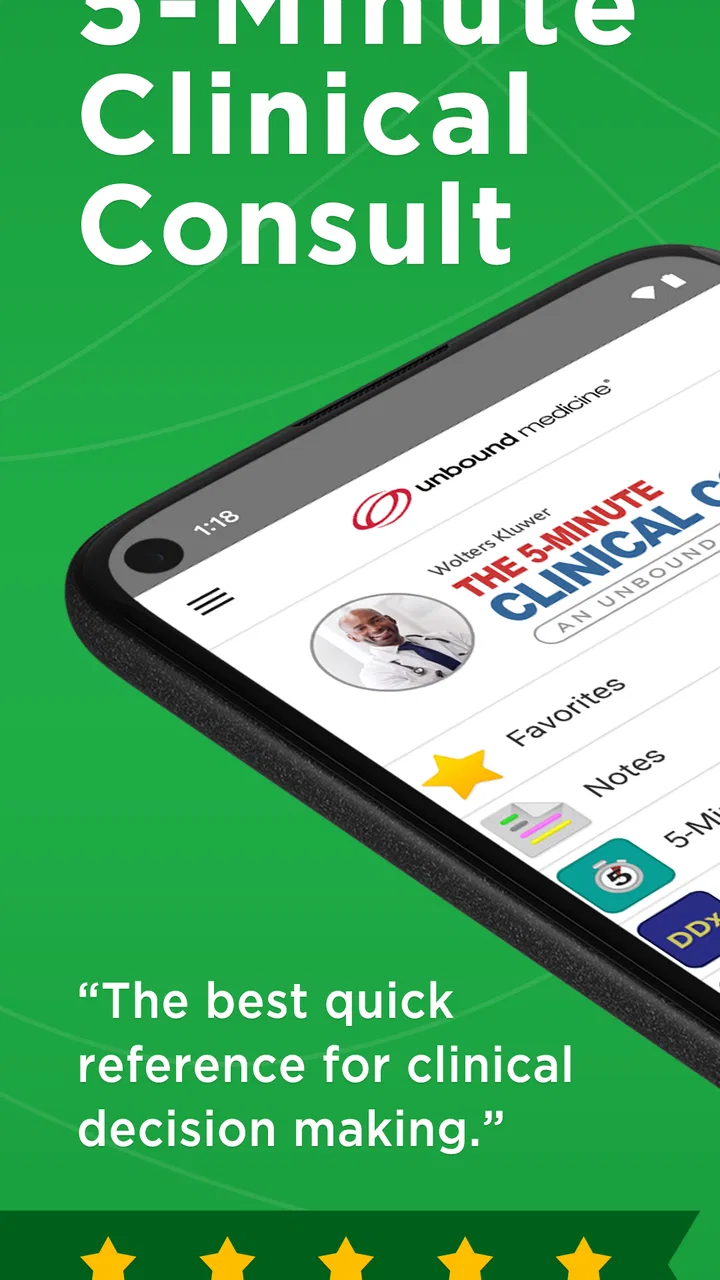
5-Minute Clinical Consult
- 4.6
- Rating
- 50.00K
- Installs
- Free
- Price

 Analysis by App-foxy
When I need a medical reference that helps me move from a symptom or clinical question to a focused review quickly, 5-Minute Clinical Consult is the kind of app I reach for first. Its central idea is simple: provide compact clinical guidance that can be checked during a busy shift rather than forcing me to work through a long textbook chapter. That focus gives the app a clear identity, and it also makes its limitations easier to understand.
Developed by Unbound Medicine, Inc, this free medical app is aimed at practical point-of-care reference rather than general health education. The store presents it as the 2026 Edition with Bonus Features, while the short description identifies it as 5-Minute Clinical Consult. I found that its real value is not in replacing formal training or clinical judgment, but in helping an informed user organize the next step when time is limited.
The app is rated for Everyone, although the subject matter is clearly more useful to medical students, clinicians, and other health professionals than to casual users. It has an average rating of 4.6 from around 600 ratings and has passed 50 thousand installs, which gives it a solid presence among mobile medical references. The download itself is free, but optional in-app purchases range from $0.99 to $99.99 per item, so it is worth checking exactly what is available before assuming the entire reference is unlocked.
You May Also Like

 Blood Strike: 2.5 Anniversary
Blood Strike’s Loadouts Turn Every Drop Into a Tactical Gamble
A close look at Blood Strike’s custom loadouts: how fast access to signature weapons reshapes its battle royale rhythm, rewards preparation, and narrows the gap between fights.

 Pandora - Music & Podcasts
Pandora’s Music Is Easy to Start, but Harder to Recover
Pandora’s strength is its low-effort path from a seed to a station. Its weak spot is how much confidence it asks you to place in connection, setup, and quiet recovery.

 8 Ball Pool
 Is Built on Rivalries, Rematches, and Routine
A close look at the rivalries, rematches, shared routines, and unanswered safety questions that turn a quick pool match into a persistent mobile community.

 Samsung Music
’s Quiet Strength Is Playing What You Already Own
Its reach comes less from spectacle than from dependable access to a personal library. That simplicity is both the app’s strongest retention engine and its ceiling.

 AccuWeather: Weather Radar
AccuWeather Review: A Quick, Clear Forecast for Everyday Decisions
For everyday plans, the best forecast is the one you can understand quickly. AccuWeather makes rain timing, radar, and local conditions easy to act on, with a few trade-offs.

 Hill Climb Racing
Why Hill Climb Racing Still Turns Crashes Into One More Run
A tiny car, a bumpy hill and one more upgrade: Hill Climb Racing keeps resurfacing because its simple chaos makes every near-miss feel personal.
More From Our News Desk
View All News


Why the concise clinical format matters
I use a concise clinical reference most effectively when I treat it as a way to frame a question, not as a shortcut to a conclusion. This section looks at how that format can make a quick review more purposeful, including a practical habit for checking whether a brief summary is enough for the situation at hand.
A reference designed around the next decision
The capability I noticed most is the app’s compressed clinical format. Instead of treating every topic like a full textbook entry, it is built around the information a user commonly needs first: recognizing a condition, separating it from similar problems, considering evaluation, and thinking through management. That structure changes how I use it. I do not open it expecting a complete lesson; I open it when I need a dependable framework for a focused question.
This is especially helpful when the problem is not a lack of knowledge but a lack of time. During a busy day, I may remember the broad outline of a condition but want to refresh the key distinctions before discussing it with a supervisor, preparing a patient presentation, or reviewing a plan. A short clinical entry is easier to scan than several pages of a conventional reference book.
The strongest benefit is decision support through compression, not diagnosis by automation. The app does not turn an uncertain symptom into a safe diagnosis on its own. Its usefulness depends on the reader already understanding the situation, recognizing warning signs, and knowing when a quick reference is not enough. I see it as a structured memory aid and a starting point for deeper verification.
How I use it without treating it like an authority
My most practical workflow is to begin with the condition or clinical topic I am already considering, then use the entry to check whether my mental outline is missing an important element. I pay attention to the way the topic is organized rather than reading every line automatically. The compact presentation makes it easier to compare the main issue with nearby alternatives and identify what deserves more attention.
That workflow is more useful than searching the open web because general search results mix professional references, patient websites, advertisements, and outdated explanations. 5-Minute Clinical Consult keeps the task closer to a medical reference context. It also avoids the opposite problem of opening a large textbook and losing the original question in a mass of background detail.
There is a trade-off here. Concision removes context. A short entry may remind me what to consider, but it cannot reproduce the full discussion I would find in a major textbook, a specialty guideline, or a detailed evidence review. I therefore use it before or alongside those sources, not instead of them. If the situation is high risk, unusual, rapidly changing, or outside my training, I would deliberately move to a more comprehensive source and seek appropriate clinical supervision.
A realistic everyday scenario
Imagine a student preparing for rounds after seeing a patient whose symptoms could fit several common conditions. The student may not need a forty-page chapter at that moment. What they need is a quick way to review the defining pattern, remember which competing explanations matter, and arrive at the discussion with a more organized set of questions. This is where the app makes sense: it can turn scattered recall into a short checklist for further thinking.
I would use it in the same way before a teaching session or while preparing a handoff. I would first identify the topic, scan the relevant entry, and write down the points that need confirmation from the patient record, a supervisor, or a more authoritative source. The app is most helpful when it improves the quality of the questions I ask next.
It can also help during study breaks. Instead of reviewing a topic only through long-form reading, I can use a concise entry to test whether I remember the major clinical approach. The important tip is to use the app actively: pause before reading the management portion, state what I think should happen, and then compare my reasoning with the reference. That turns a quick lookup into a small learning exercise.
Where the short format saves real time
The format is particularly well suited to situations in which I already know the vocabulary of medicine. A clinician or student can usually interpret a compact entry quickly because the terminology is familiar. The same compression may feel abrupt to a person without medical training, who may need definitions, examples, and explanations that a point-of-care reference is not designed to provide.
Another useful habit is to treat the app as a navigation aid. If a topic reminds me that a case has several possible directions, I can use the concise overview to decide what deserves a deeper search. In that role, the app reduces wasted reading. It does not answer every question, but it helps me choose the next source more intelligently.
I would not use it as a patient-facing handout without translating the material into plain language and checking the context carefully. Medical summaries can be misunderstood when separated from an examination, history, test results, and professional interpretation. For personal symptoms, a healthcare professional remains the right person to assess what the information means.
Trade-offs created by the app’s focus
The same feature that makes this reference convenient also creates its biggest weakness. A concise entry can encourage overconfidence. After reading a neat summary, it is tempting to feel that a complicated problem has been fully covered. In practice, the summary should prompt better reasoning, not end it. I would be cautious about applying a general outline to a patient with multiple conditions, unusual findings, or a treatment question requiring precise current guidance.
The free price lowers the barrier to trying the app, but the in-app purchase range means the experience may depend on which content or bonus material a user chooses to access. I would review the available purchase details inside the app before building a study routine around a particular section. The difference between trying a reference and relying on its full library can matter, especially for students managing a limited budget.
There is also a platform consideration. The current version is 2.8.52 and the minimum operating system is iOS 9, so the app supports a broad range of Apple devices. That is convenient for people using older hardware, although anyone with a newer device should still keep the application updated when updates are available. The release history begins on May 11, 2015, which shows that this is an established product rather than a newly launched experiment, but age alone should never be treated as proof that every clinical detail is current.
My other reservation is that a general clinical reference cannot be equally deep in every specialty. It is a useful first stop for broad clinical review, but a specialist facing a narrow question may get more value from a dedicated specialty resource, institutional guidance, or a current primary source. Choosing the right reference is part of safe use. The app is strongest when the question matches its concise, general clinical purpose.
Who will gain the most from it
Medical students are likely to get the clearest benefit. The app can support preparation before rounds, quick revision between classes, and structured recall before an examination. It is also useful for learners who know that their problem is not finding more information but finding the important information quickly. I would recommend it as a companion to textbooks and teaching, especially for turning broad topics into manageable review sessions.
Residents and practicing clinicians may appreciate it as a fast refresher when a familiar topic needs a quick mental reset. The value is greatest when the user already has clinical experience and can judge whether the summary fits the case. It can help prepare for a conversation, organize a differential, or identify areas requiring confirmation, but it should not be the only source behind a consequential decision.
Educators could also use the concise structure to create discussion prompts. A teacher might ask learners to predict the key evaluation steps before opening the relevant topic, then use the entry to reveal gaps in their reasoning. That makes the app more than a lookup tool; it becomes a compact trigger for active learning.
On the other hand, I would suggest skipping it if you want detailed patient education, exhaustive specialty coverage, or a fully guided diagnostic system. Someone looking for help with a personal symptom may find the terminology difficult and the information too general. Someone conducting serious academic research will need sources that explain evidence, study quality, and references in much greater depth.
How it compares with familiar alternatives
Compared with a printed clinical handbook, the app is easier to carry and faster to search, but a physical book can be more comfortable for extended reading and may provide a stronger sense of context. Compared with a general web search, the app offers a more focused clinical environment, while the web may provide broader and more current material if the user knows how to judge source quality. Compared with a specialty reference, 5-Minute Clinical Consult is more approachable for broad review but less likely to satisfy a highly specialized question.
That comparison helped me define its proper place. I would not choose it because it contains every possible detail. I would choose it because it shortens the distance between a clinical topic and a sensible review plan. Its best use is the first few minutes of a question, followed by verification when the stakes or complexity demand it.
My recommendation after using it
5-Minute Clinical Consult is a practical medical reference for readers who value a concise clinical starting point. I like the way its focused presentation supports quick review, especially before rounds, during study, or when I need to organize a familiar topic without opening a much larger resource. The free entry point makes it easy to test, while the optional purchases mean I would inspect the available content before committing to a paid workflow.
I recommend it to medical students, trainees, and clinicians who understand its boundaries and are willing to verify important decisions elsewhere. I would not recommend using it as a substitute for professional assessment, detailed guidelines, or specialist advice. In my experience, the app earns its place when it helps me ask a better next question. If that is what you want from a mobile clinical reference, 5-Minute Clinical Consult is worth trying; if you need exhaustive explanation or patient-friendly guidance, a different resource will serve you better.
FAQs for 5-Minute Clinical Consult
01What is 5-Minute Clinical Consult, and who is it designed for?
5-Minute Clinical Consult is a point-of-care medical reference designed primarily for healthcare professionals and students in clinical training. It provides concise information on diseases, disorders, symptoms, diagnostic approaches, treatment options, and follow-up considerations. The app is most useful for physicians, nurses, physician assistants, pharmacists, and medical students who need fast access to structured clinical content rather than general health advice for patients.
02Does 5-Minute Clinical Consult work offline?
Offline availability depends on the version, subscription, and content package associated with your account. In general, users may need to download or synchronize reference content before relying on it without an internet connection. It is a good idea to open the app while connected to Wi-Fi, sign in, and confirm that essential topics are accessible offline. Availability and offline features can change after updates or subscription changes.
03Is the information in 5-Minute Clinical Consult a substitute for professional medical judgment?
No. The app is intended to support clinical decision-making, not replace professional training, institutional protocols, examination, or consultation with specialists. Medical information can change, and individual patients may have allergies, comorbidities, contraindications, or other factors that require a customized approach. Always verify important recommendations, especially medication doses and emergency treatment decisions, against current authoritative sources.
04What kind of clinical information can I find in the app?
The app generally organizes practical reference material into searchable clinical topics, making it possible to review conditions, signs and symptoms, diagnostic considerations, management strategies, and patient-care information in a compact format. Depending on the edition and access plan, it may also include calculators, tables, images, references, or links to related topics. The exact tools and depth of coverage can vary by platform and subscription.
05Is 5-Minute Clinical Consult free to download and use?
The app may be available to download at no initial cost, but full access to its clinical reference library commonly requires a paid subscription, institutional access, or an eligible purchase. Before installing, check the current Google Play or App Store listing for pricing, trial terms, renewal conditions, and included features. Users should also confirm whether their school, hospital, or employer already provides access through an organization-wide subscription.
Pros
- Quick access to concise
- point-of-care clinical references
- Covers diagnosis
- treatment
- follow-up
- and prevention information
- Useful for reviewing common conditions before patient encounters
- Search tools help locate topics faster than browsing manuals
- Regularly updated content can support current clinical decision-making
Cons
- Best suited to healthcare professionals
- not general health consumers
- Full access may require a paid subscription or institutional login
- Some advanced features depend on an internet connection
- Brief entries may not replace detailed guidelines or specialist advice
- Content can feel dense for students unfamiliar with medical terminology

5-Minute Clinical Consult
Gallery